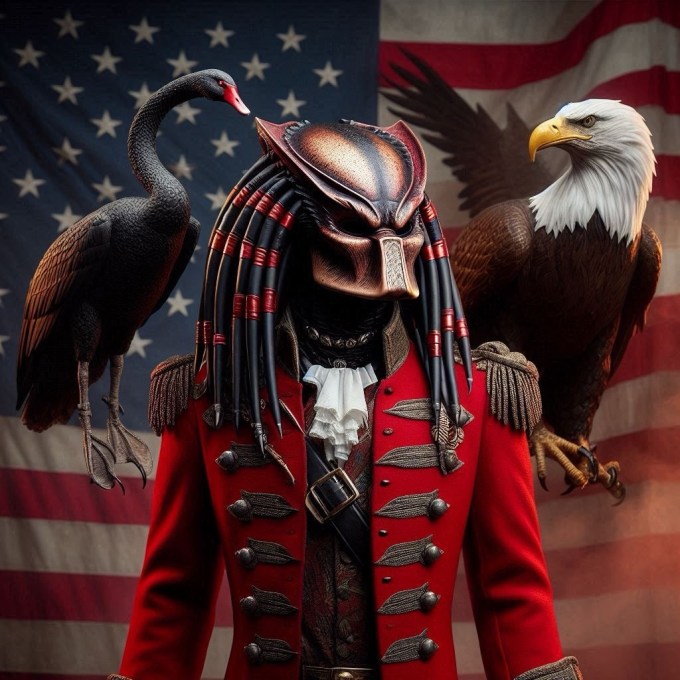
You know, on the surface, Predator (1987) might seem like just another brainless action movie. A bunch of muscle-jacked, testosterone-fueled soldiers—led by none other than Arnold Schwarzenegger—unload endless rounds of munitions into the jungle, trying to kill an alien that looks like it’s straight out of a nightmare. It’s got all the typical ingredients for a mindless thrill ride: explosions, epic one-liners, and an alien showdown that you know Arnold’s going to win. But look deeper, and there’s a lot more going on here.
What if I told you Predator isn’t just a sci-fi action flick, but a masterclass in strategy, adaptation, and survival? And what if I told you that some of the smartest insights from books like Super Thinking and Black Swan by Nassim Taleb are hiding within this movie’s jungle? Let’s go even deeper and connect it to the way the American Revolutionary soldiers changed the game against the British. Buckle up, because we’re about to dive into this beast with fresh eyes.
Changing the Game: Super Thinking in the Jungle and the American Revolution
So let’s talk about Super Thinking by Gabriel Weinberg and Lauren McCann. It’s a book all about mental models—those little frameworks that can help you think clearer, make better decisions, and navigate complex situations. In Predator, Dutch (Arnold’s character) finds himself in a totally lopsided fight. He and his team of highly trained soldiers are up against an alien with advanced technology, and one by one, they’re picked off. The Predator is superior in almost every way: technology, strength, and even thermal vision that can track humans through their body heat.
But here’s where Dutch changes the game. When he accidentally covers himself in mud and realizes the Predator can’t see him anymore, he’s using a classic mental model: changing the rules. Instead of fighting on the Predator’s terms, he adapts and uses unconventional tactics (mud as camouflage, homemade traps) to level the playing field. This is a perfect example of what Super Thinking refers to as the power of changing your approach when the odds are stacked against you. Instead of brute force, he uses strategy.
Doesn’t this remind you of how the American Revolutionary soldiers changed the game against the British? They knew they couldn’t win in traditional open-field battles where the British excelled. Instead, they used guerrilla warfare—hit-and-run tactics, ambushes, and their knowledge of the terrain—to fight on their own terms. They hid in forests, using the element of surprise and unconventional methods to outsmart a far superior force. Just like Dutch, they didn’t have the technology or numbers, but they had strategy.
That’s a lesson we can all apply to our lives. Whether it’s in business, sports, or relationships, sometimes brute force won’t work. You need to think differently. And that’s where books like Super Thinking can help you build the right mindset.
The Black Swan Moment: The Predator’s Blind Spot (and the British Army’s)
Now, let’s take this to the next level with Nassim Taleb’s Black Swan. Taleb describes Black Swans as rare, unpredictable events that have a massive impact. They’re things you didn’t see coming, but when they hit, they change everything. The Predator? It’s the epitome of confidence. It’s hunted species across galaxies and never faced a real challenge. Its thermal vision and advanced tech give it an undeniable advantage—until Dutch comes along and accidentally discovers its weakness: the Predator can’t see him if he covers himself in mud.
For the Predator, this was a Black Swan event. It never expected this low-tech, mud-smeared human to figure out such a critical flaw. And that’s a key takeaway for all of us. We’re all going to face Black Swans in life—those unexpected challenges that completely flip the script. It could be a financial crisis, a sudden health issue, or an unforeseen obstacle in your career. The question is, are you ready for it?
This is the same kind of shock the British faced in the American Revolution. They were used to fighting armies that played by the same rules they did. They weren’t prepared for a ragtag group of revolutionaries to fight dirty, hide in forests, and attack by surprise. It was a Black Swan for the British—something they hadn’t anticipated, which drastically altered the outcome of the war.
That’s why Black Swan is an essential read. Taleb shows us that instead of trying to predict the future (which we’re really bad at), we need to build systems—and lives—that are resilient to the unexpected.
Embrace the Chaos: Antifragile
While we’re on Taleb, I’ve got to mention his other game-changer: Antifragile. This book takes the idea of resilience to the next level. It’s not just about surviving chaos—it’s about thriving in it. Think of Dutch again. He doesn’t just survive by hiding from the Predator. He adapts, learns, and turns the jungle into his own weapon. He thrives in the chaos and uses it to defeat an enemy far more powerful than himself.
That’s the essence of being “antifragile.” It’s about being adaptable and getting stronger when you’re tested. If you can build this into your mindset and your life, then when the next Black Swan hits, you won’t just survive—you’ll come out better, sharper, and more capable.
The American Revolutionaries were antifragile, too. They weren’t crushed by the superior British force—they thrived in the chaos of guerrilla warfare, adapting to the challenges and turning weaknesses into strengths. They built a new way of fighting that not only helped them win battles but also changed the course of history.
Conclusion: Predator and the American Revolution as Life Lessons
So, the next time you watch Predator, don’t just see it as a mindless action movie. There’s a deeper message there if you look closely. It’s a film about strategy, adaptation, and surviving the unexpected. Dutch doesn’t win because he’s the strongest or most heavily armed—he wins because he outthinks his opponent, changes the game, and adapts to the situation. That’s the kind of mentality we should all strive for in life.
The same goes for the American Revolution. The colonists didn’t have the best army or the most advanced weapons, but they changed the rules, embraced the chaos, and came out stronger. These are powerful lessons we can apply to our own challenges.
If you want to dive deeper into these kinds of ideas, I recommend checking out Super Thinking, The Black Swan, and Antifragile. These books aren’t just for intellectuals—they’re for anyone who wants to change the game in their life journey. Read them, internalize them, and you’ll start seeing the world in a whole new way.
Now, go out there and get after it!
Books to Consider:
• Super Thinking: The Big Book of Mental Models by Gabriel Weinberg & Lauren McCann
• The Black Swan: The Impact of the Highly Improbable by Nassim Nicholas Taleb
• Antifragile: Things That Gain from Disorder by Nassim Nicholas Taleb


 AmpedThink